
Avicenna’s argument for the immateriality of the intellect

Tracing the stages of cognition in Avicenna’s argument for the intellect’s immateriality
Written by Ahmad Nassar: Mathematics & Computer Science (Double Major), Philosophy (Minor)
Is there something immaterial about us? This question has puzzled many great philosophers throughout the ages. Amongst such great philosophers, Avicenna considered the question seriously and eventually developed an interesting argument for the immateriality of the mind. Prior to rendering the argument, I explain the various stages of cognition based upon the Shaykh’s (Avicenna) work in his psychology. This will consist in first explaining what it means to cognize things via the different faculties of cognition, such as the external sense faculties, the internal sense faculties, and, finally, what intellection properly amounts to (it’s at this stage of cognition that one is properly said to have knowledge). Avicenna argues that, if we are to cognize things in themselves, the mind must be immaterial.
External sense cognition
According to Avicenna, all cognition is nothing but taking in the form of the object of cognition in one way or another. For example, cognition of sensible material objects in the extra-mental world depends on having organs (e.g., eyes, tongue, etc.) that possess powers to receive the forms of things. In this article, I focus only on how cognition works for one of the five senses, namely vision, although cognition via touch, smell, taste, and hearing, work in a similar way.
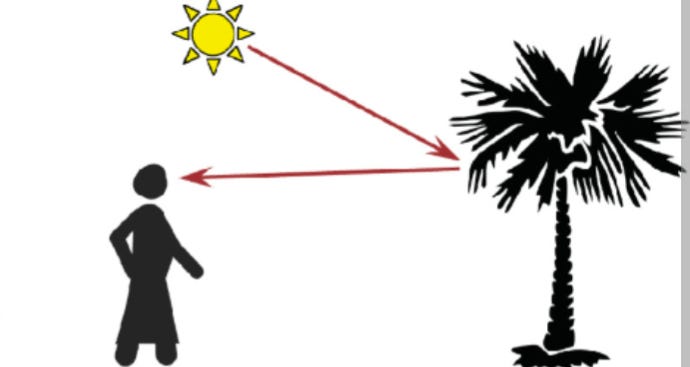
Avicenna, following Aristotle, was committed to the intromission theory of Vision. Briefly, this theory states that for vision of a sensible object to occur, light has to reflect off of a material object and impress upon the vitreous humor in the optical nerves. It is only if such optical nerves have the receptive powers that the forms of sensible objects can be impressed. The following image, which illustrates a beam of light emanating from the sun and reflecting off of a tree towards the optical nerves of an individual, captures the idea behind this theory:
A sensible form is, once perceived, stored in the retentive imagination. Of course, cognition of a particular form at this basic level is contingent upon matter, i.e., once the perceiver turns away from the object, the form that inheres in the material object is no longer perceived by the perceiver.
Internal sense cognition
For Avicenna, imagination and estimation are two kinds of internal sense perception. Intellection, however, ought to not be considered as an internal sense, as the internal senses receive forms that are material, and the intellect only receives forms that are immaterial. We’ll see why that is so shortly. As for imagination, it consists in cognizing a particular form that was grasped by one of the external senses and stored in a part of the brain.
Estimation is a bit more complicated. Avicenna believed that there are non-sensible forms of material objects, i.e., non-sensible via the external senses, that we nonetheless cognize. To see how this works, imagine a sheep that encounters a wolf. The sheep immediately perceives the sensible image of the wolf, but it also perceives non-sensible forms of it, such as its danger. How does this happen? According to Avicenna, the sheep cognizes the danger of the wolf by virtue of the faculty of estimation, which is able to receive non-sensible forms that belong to material objects (e.g., time, space, fear, joy, etc.). Finally, intellection is to cognize the universal forms devoid of matter and its concomitants. I’ve already mentioned that cognition at the basic level is contingent upon the form inhering in matter to be perceived. Similarly, the form in the retentive imagination, albeit independent upon matter to be cognized, still nonetheless possesses the concomitants of matter (e.g., space, color, joy, etc.). However, in order for a form to be impressed upon the intellect, it must be completely abstracted from matter and its concomitants.
The intellect has the marvelous ability to cognize a form in a more abstract way by virtue of extracting its essential features (e.g., the genus {animal} and difference {rational} of a human) and abstracting away its accidental features (i.e., the sensible and non-sensible features that follow upon a form by inhering in matter). Now, I’ve already said that forms – which are cognized via the external and internal senses – are still in some way or another dependent on matter which particularizes the forms. Indeed, this is how such forms are impressed upon their corresponding organs that possess the required receptive powers and are eventually stored in parts of the brain.
The forms that are devoid of matter and its concomitants, however, are universal. Indeed, for Avicenna, it is precisely because the forms are universal that they are immaterial. In other words, if something is universal, then it’s immaterial. The immediate question that comes to mind is: Can universal forms be cognized by the intellect if it is material? Avicenna answers negatively. Therefore, the intellect has to be immaterial to cognize the universal forms. This motivated Avicenna to develop an argument for the immateriality of the intellect, which I will now discuss.
Argument for the intellect’s immateriality
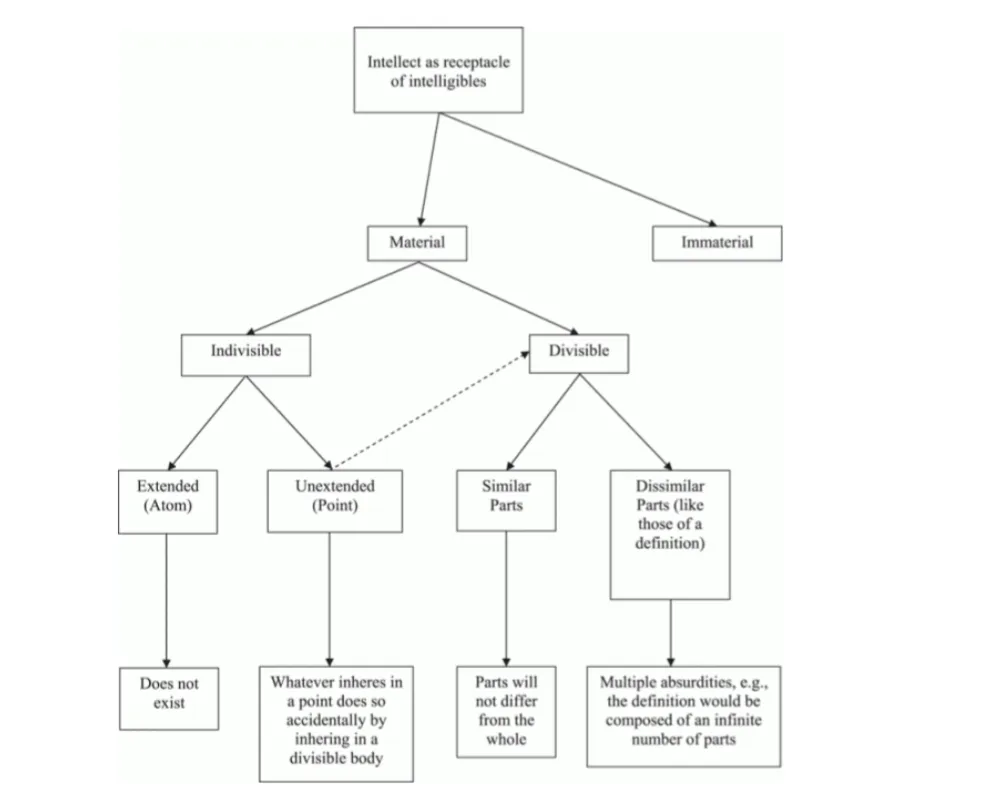
There are a few arguments that Avicenna gives to prove the immateriality of the intellect. The most famous one is a reductio ad absurdum kind of argument. To see how it works, assume that the intellect, which receives the universal forms, is a material intellect. Furthermore, according to Avicenna, a material thing is either divisible or indivisible. Thus, it follows that the material intellect is either divisible or indivisible. If the material intellect is indivisible, then either it is extended (and so is an atom) or not (and so is a point). Now, a point, Avicenna tells us, is a certain termination of a divisible material body and as such a point has no existence independent of that body. Therefore, whatever inheres in a point does so by inhering in a limit of a divisible body. So, for example, one might say that a particular colour inheres in some point on a table because the surface of the table is coloured, and the point is a limit of the table’s surface. So, if the intellectual forms were to be impressed upon the intellect in a similar way, they would be impressed in some point of the divisible material intellect. Consequently, the question regarding whether or not intellectual forms can inhere ina point depends upon whether or not they can inhere in a divisible body, which I will treat shortly.
The alternative option, namely the material intellect is an indivisible yet extended body, is also problematic. Avicenna argues in his work on natural philosophy that atomism is false. I will briefly lay out his argument against it. Assume three atoms are in contact with one another so as to form a line ABC. Now, either B separates A and C or it does not. If B separates A and C, such that A and C do not touch, then B can be divided into two sides: the first side that touches A, and another side that touches C. However, this contradicts our assumption that atoms are indivisible, which is absurd. Now, if B does not separate A and C, such that A touches C, then B is not an extended atom as was originally assumed, which is contradictory. Therefore, the material intellect is neither an extended nor a nonextended indivisible body.
I will now consider the material intellect as a divisible body. Consider some intellectual form, X, that is impressed upon a divisible material intellect. Now, since the intellectual form inheres in such material intellect, a division of the intellect implies the accidental division of the intellectual form. For example, consider a table that has its surface coloured. According to Avicenna, if we divide the table into two parts, then the colour which inheres in the table’s surface would be divided into two parts as well, albeit accidentally. (Note: Avicenna was a property realist; he considered quantitative and qualitative properties to really belong to substances). Now, if the intellectual form is accidentally divided into two parts by virtue of dividing the material intellect into two parts, then the intellectual form’s parts, observes Avicenna, must either be similar or dissimilar. ‘similar’ here means that the parts and the whole are the same kind of things. For example, if you divide fire in half, the halves would also be fire. ‘dissimilar’ means that the parts and the whole are not the same kind of things. For example, if you divide a dog in half, the halves would not be dogs.
So, firstly, the two parts of the intellectual form cannot be similar. This is because recombining the two parts of the form so as to make a whole, the whole would be no different from the part, yet a whole is different from a part. It wouldn’t make sense to say that the whole of the intellectual form is greater in size, shape, or number, than its individual parts. The reason is that the intellectual form is immaterial, and immaterial intellectual forms are completely devoid of matter and its concomitants.
If the two parts of an immaterial intellectual form are dissimilar, and that dissimilarity cannot be explained by reference to material concomitants, then these dissimilar parts must correspond with the parts of a definition, namely, genus and difference. For example, consider the intellectual form of humanity. It can be divided into animal (genus) and rational (difference). Assuming the receptacle of such intellectual form is a divisible material body, it would be continuous, and, according to Avicenna, continuous divisible bodies are potentially divisible infinitely. It follows that the intellectual form inhering in a continuous body would have a potentially infinite number of genera and differences. However, Avicenna takes it as a fact that essential genera and differences are not infinite, but finite. Moreover, it simply makes no sense to say that a genus or difference can be potentially divided ad infinitum. That would be tantamount to saying that rationality is potentially divisible ad infinitum; it is not clear how this is even coherent.
Given the absurdities that follow from assuming the claim that the intellect is a material body regardless of whether it is considered as divisible or indivisible – it ought to be rejected as a false claim. The intellect is, therefore, immaterial. The argument can be rendered in a simpler way using the following flow chart (McGinnis, Avicenna, page 255):
Conclusion
To conclude, I’ve shown that for Avicenna, cognition of intellectual forms depends upon a process of extracting the essential features of a form by abstracting away its accidental features. This process occurs at various levels of cognition. Moreover, the assumption that the intellectual forms are impressed upon a divisible or indivisible material intellect leads to an absurdity. Therefore, the intellect must be immaterial.